How's your relationship with your art?
A very earnest series of questions in which I get all woo-woo about writing, and remembrances of my former colleague Peter Christopher.
On a recent podcast interview with on Finding the Throughline, I started talking about my relationship with my writing. I had a great time talking with Kate. and I swore and got excited about writing, but then afterward that phrase “my relationship with my writing” stayed with me. It made me think about so many classrooms and hundreds of students—and especially those who come in saying “I’m a bad writer.” The first thing that hopefully happens with such students is that some of that damage be mended.

I don’t think that damage is intentional; I think it’s done in the service of meeting academic standards. Currently, protecting a student’s sense of themselves as a creative being isn’t one of those standards. So one of the first goals and a marker of a successful class is having multiple opportunities to rebuild that relationship, to open other channels to experimentation and self-expression. And here I’ll say something unfashionable or maybe even problematic or not serious: because it’s good for people.
Talking with Kate, and lots of talk about writing process over the years, got me thinking about my own relationships to writing and how it’s changed over time.
If your relationship to writing were a relationship to a person, what would it look like? Would it be fraught, even strained? Would it be utilitarian: I am happy if I get X or Y from my writing? I am happy if I meet a certain word count? Are you able to go to your writing for solace? For refreshment and calm? Sometimes writing is a mirror, reflecting everything I don’t like about myself. Sometimes it’s a life raft. Sometimes it’s seeds that I hope will come up from the soil as plants.
Our outputs and outcomes are constantly evaluated in so many realms of life. How far we reach, how many days we meet targets. I have tried for a long time in my creative writing syllabi to loop outcomes back to process, to create a goal of making process more loose and playful, to have students understand that process is more important than product.
This is where the needlessly binary “writing isn’t therapy” debate gets a little confusing for me. Because I gotta say that it is very good for me as a whole person to have a relationship with writing where it is the safe space that I can play. (I talk about this with Kate, too.) Sitting at my desk for the hour of writing is the only place I am free of conflicts, targets, outcomes, pain, and evaluation. As a sort of spiritual well-spring, this practice keeps me in touch with that part of my soul and the belief that a non-outcomes mindset is good for humans. It’s good for me. It’s centering, it’s a daily re-orientation. I might be reading into it, but this is where the goal of separating writing from writing as high art runs off the rails from my daily experience.
A lot of my writing is terrible. But it’s good for me as a whole person to do it. It adds to my life. And through the bad writing, I begin to figure out what I want to say. For me it’s not “writing isn’t therapy,” but “the seventy-seventh draft is probably better.” But writing is definitely good for me, and that’s why I’m so interested in writing process.
The rewards are not on the page. The traces of them are, but engaging in the process—failing, needing humility, requiring a sort of playful what-next attitude in order to find the words that happen to hang together well—creates the most benefit. I think the benefit comes from working out hard and complex problems on the way to making something that sounds good; it requires a certain loose focus, and that looseness is good for my soul. It’s shaped my personality and taught me a certain way to be as a person.
This is now, but I also know that in the past, I would go to my writing with a sort of wringing hopelessness: will I ever be any good? Why is this piece or this whole book not working? Do I have anything to say? Only the writing process itself distracted me from those questions.
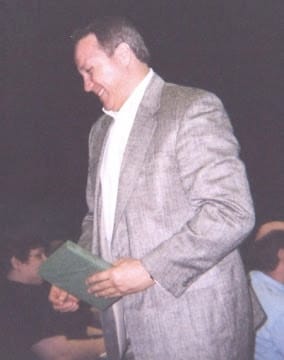
A dear colleague of mine from Georgia Southern University, Peter Christopher, used to say, “When the writing’s going well, everything’s going well.” I think by this he meant that when the writing is happening, everything else feels good, because that channel is open. Sometimes writing can feel blocked, or you can have a feeling that your idea isn’t clicking, and this might also feel like you’re “not writing,” but I often see this as the knot at the beginning of something that will probably untangle at some point down the road. (I’m gonna write more about this in another post in a few weeks.)
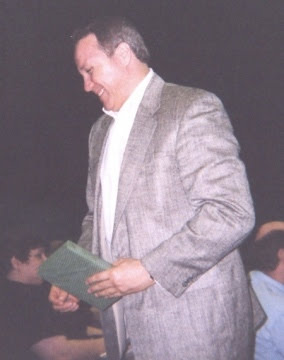
And my other colleague, Eric Nelson, said that when Peter was in his last days in the hospital before his death from liver cancer on April 15, 2008, he kept trying to get out of that bed to go write.
That could be seen as a sort of driven habit (as people sometimes describe me, or as the “write every day if you can” advice is often caricatured, rather than adding “but don’t if you don’t feel like it,” which is of course the truth). But it’s the opposite: it’s wanting to visit a wellspring, a cooling place that provides comfort and requires only that we let down our guard.
Telling someone they’re bad at writing is like telling them they’re bad at prayer or love. How can damage to a central life process not occur in the wake of that wound?
And don’t get me wrong: I don’t go to my desk all sweetness and light. I will very often refer to my current project as “that fucking book.” It’s a huge puzzle that I’ve made for myself and it never seems to be working. And yet it has an internal logic and it opens like a funhouse, and maybe it will work. And if it doesn’t (that happens) then the pieces can be used for something else.
I think this should be our goal: how to get to the place where the relationship with writing is good, where it gives back, where it makes you feel good because the attitude with which you approach it is an attitude that makes life as a whole more pleasant. I realize these half-formed thoughts run contrary to a lot of
But this is how it’s been for me, since when I first really started writing seriously: my hand in spiral notebooks, writing chunks of a novel on the T in Boston on the way to and from a terrible and stressful job in social services: I needed another world to be inside. That novel was a place I could go. It was a novel that will never be published, and I worked on it for years, and that’s okay. I have a handful of failed books. It taught me a good deal about writing, and maybe more importantly, it let me see and understand my own process. It allowed me to explore ideas in a world that reflected my sensibilities and questions back at me.
This is unorthodox, and it’s very far afield of conversations about craft. It’s a little woo-woo, but it’s how I feel. How’s your relationship with your writing? What does it feel like? I’m also interested in the problems I’m not seeing that may be embedded in these questions, so let me know those too.
In other news, I’m on a virtual panel on Disability Justice at the Writers & Books Conference, April 26-28 in Rochester, NY: From Margin to Center.
“Award-winning poet, playwright, translator, and essayist Nathalie Handal headlines as keynote speaker. Prominent authors, poets, translators, and thinkers Nishant Batsha, Cyrus Cassells, Ingrid Rojas Contreras, Jeffrey Davis, Kathy Engel, Annie Finch, Mary Gannon, Sonya Huber, Isle McElroy, Saretta Morgan, Tracie Morris, Tamara Payne, Iain Haley Pollock, Matthew Zapruder, Leni Zumas, and many others will engage with such topics as Afrofuturism, Disability Justice, The Feminist Romance Novel, LGBTQ + Literature, Migration: Crossing Borders, New Forms in Memoir, Reproductive Freedoms, Starting a Small Press, Structural Repetition: Building a Stronger Poetry Collection, and Translation: Expanding Our Horizons. Two experienced literary agents will offer Pitch Session opportunities. A full calendar of events can be found here: wab.org/literary-conference.”