Jeff Dorchen's Sinéad essay: "Ketch Vampire"
Read this great essay about Sinéad O'Connor and send us your writing!
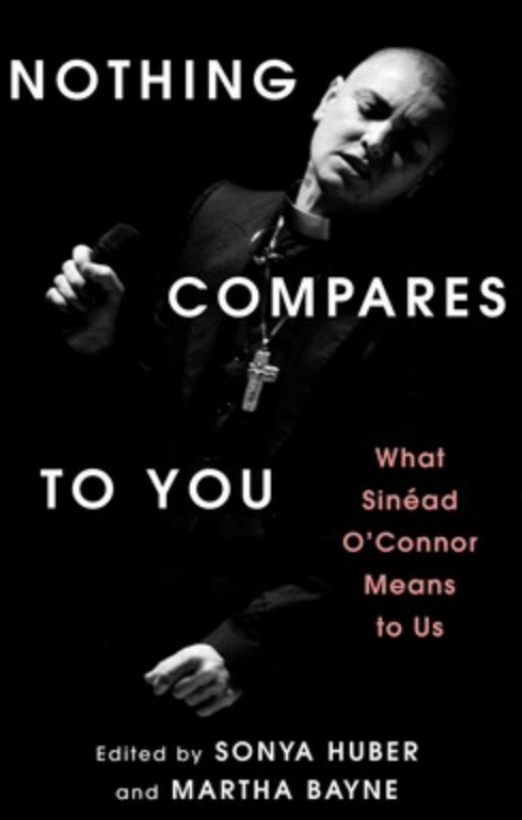
This summer, I am running a series of essays about Sinéad O’Connor to celebrate the publication of our almost-here book: Nothing Compares to You: What Sinéad O'Connor Means to Us. First up: ’s Kenneth Dorchen.
Do you have an essay, flash piece, or a few paragraphs about Sinéad you'd like to share? Please send pieces of 2,000 words or fewer to sineadanthology@gmail.com. We’d like to run these through the summer so you can consider the deadline to be August 31, 2025.
Ketch Vampire
Jeff Dorchen
Sinéad’s album of reggae covers, Throw Down Your Arms, is a tribute to the original artists and their genre and culture that was crafted with utmost respect. It was a passion project of hers, one she sunk hundreds of thousands of her own personal dollars into. Ten percent of profits from the record’s sales were tithed to a fund for Jamaican Rastafari elders. She worked in the studio with Sly and Robbie, the rhythm and production team who made enormously influential contributions to mid-seventies reggae performance and production sounds.
When I was introduced to Throw Down Your Arms, the most important track seemed to me to be “Downpresser Man,” original by Peter Tosh. But that might have been because the person who introduced me to the record kept singing that song. Later she shifted her focus to “Vampire,” possibly because I had it on continual repeat, so absorbed was I by the very notion of a reggae song about Rastafari hunting the bloodsucking undead.
Obadiah obadiah
Jah Jah send us here to catch vampire (2)
We have a chalice to light up Jah fire
When I and I catch them vampire
I and I a-go to set them on fire
Or, as Devon Irons sang it on the original single:
Obadiah obadiah
Jah Jah send us here to ketch vampire (2)
I have a chalice to light up Jah fire
When I and I ketch dem vampire
I and I a-go to set dem afire
(Italics mine.)
The woman who turned me on to the record was an exceptionally talented singer herself, and I hope she still is. On the lyric, “Jah Jah sent us here to catch vampire,” she would sing the name of God with a soft “j”: zja zja. As men have the unappealing inclination to do, I corrected her. And as my Olympic mansplaining strong suit is in the event known as “correcting pronunciation,” I will compete with anyone of any gender. In this case I believe my legs on which to stand were very stable and two in number. My opinion was and remains that the mission of the Rastaman to ketch vampire entailed no involvement or authority whatsoever from any of the Gabor sisters.
The Devon Irons version produced by Lee “Scratch” Perry is a recursively rotating machine drowning in echo and reverb, giving the Rastaman’s mission to ketch and kill down vampire an eternal, metempsychotic quality.
Sinéad’s cover heels very closely to the original, but without the almost distorting cranked-up wetness of the echo. Sinéad’s commercial voice always has some reverb on it. It complements her timbre, which has a light hint of “tooth” behind it, like the texture of watercolor paper. It gives her voice what I think of as the authority of past suffering, a bit of bitterness, even, while the reverb lends the haunting quality that, in video, is re-enforced by her striking appearance.
Interesting to me on that score is the duet she and Shane McGowan released ten years before Throw Down Your Arms came out of his song, “Haunted,” originally recorded by Cait O’Riordan and The Pogues a decade before that. No two voices could contrast more than O’Connor’s and McGowan’s. Sinéad’s vocals are quite noticeably echoey and even slightly doubled, while Shane’s are, as usual, as dry as neglected terrarium gravel. Sinead’s almost seem the commentary of a Greek chorus behind Shane’s foreground sandpaper origami. That they blend so well on the track is a minor aesthetic miracle.
But whereas her use of reverb on her cover of “Vampire,” as it is on “Haunted,” is tastefully restrained, Devon’s, under the hand of Lee Perry’s production, is cranked to overloading, almost dire. What comes across to me when I compare the two is that Sinéad is reporting after the fact on her mission to catch vampire while Devon seems more in the midst of the hunt. For this reason, of all the songs on Throw Down Your Arms, an album of cover tracks dedicated to faithfully reproducing their originals’ arrangements, I find it the most disparate from its source.
Being of Irish extraction, Sinéad would have been perfectly within her rights during her career, at any given moment, to sing in an Irish accent, which, for unpleasant historical reasons, had no small influence on the accent generally flavoring the English spoken by Jamaicans and other Afro-Caribbeans. It’s not particularly mysterious that she never did. And it’s conspicuous and satisfying that she avoids any gesture toward such a conceit, one which sounds so ridiculous and even offensive in, say, Tom Petty’s faux-LatinX vocals on “Breakdown” and Sting’s affectations on some early Police songs. Like, what the hell were they doing? Busta Rhymes they ain’t.
Thus, Sinéad hits her “Rs” distinctly, which is why when she sings the words “vampire” and “fire” they don’t rhyme with “Obadiah.” It’s not clear what “Obadiah” refers to in the song, anyway. Is the Rastaman singing to a person or prophet or angel named Obadiah? Or is Obadiah Obadiah merely a tautophonic invocation? I lean toward the latter reading, and I would say Sinéad’s delivery supports it. Devon pronounces it “Ob-ee-diah,” although nothing about the spelling, either of the Biblical prophet’s name nor even in the written lyrics that have accompanied the original single, is conducive to such a pronunciation.
Having firmly eschewed a histrionic accent, she’s less decisive when it comes to employing Afro-Caribbean diction. If there is a rule to her choices, it might be “whatever scans best, metrically.” Thus she doesn’t sing “a true Rastaman does not drink to get drunk,” but repeats Devon’s construction, “a true Rastaman do not drink fe drunk.” Yet, in the coda, she does the opposite. Instead of Devon’s, “Babylon mash up the scene/and blamin’ the Rastaman,” she sings, “Babylon mash up the scene/and they blame it on the Rastaman.” So perhaps there is no rule, and her decisions are made on a case by case basis.
She has no problem with the Afro-Caribbean “a-go” which means “to be going.” Bob Marley famously sang, in “I Shot the Sheriff,” “Every day the bucket goes to the well/ But one day the bottom a-go drop out.” So, where Devon sings, “I and I a-go set,” Sinead also sings, “I and I a-go set” (although flawed online transcriptions render it on her version “I am nigh I go set”). But, oddly, to my thinking at least, where Devon has “I have the chalice to light up Jah fire/When I and I ketch dem vampire/ I and I a-go set dem a fire,” Sinead chooses to sing, “We have the chalice to light up Jah fire/When I and I catch them vampire/I and I a-go set them on fire.”
Why, “on fire,” I wonder. “Set them afire” would be both dialectically authentic and adherent to usage in the so-called “King’s English.” It’s not a big deal, of course, because nothing is a big deal unless someone makes it into one. As an essayist, that is pretty much all I do: find opportunities to make small deals big. And although I’m not going to get too exercised over “afire” vs “on fire,” I’m more vehement about the change from “Babylon mash up the scene/and blaming the Rastaman,” to “Babylon mash up the scene/and they blame it on the Rastaman.” It seems to me not just a choice but a grammatical correction, and I don’t like it.
But even my biggest, most vehement deal shrinks to insignificance in the face of the very existence of the album and the devotion, motivation, and respect Sinéad put into making it. The fact that she chose to cover “Vampire” at all is worthy of a special Grammy award for inspiration wedded to chutzpa. Maybe even a special Nobel literary category for musical adaptation. Where Devon Irons sings,
I-man trod up down a unity lane
See a Dreadlocks running down a Rastaman
Swear that if him catch him, him will kill him down
The Dreadlocks couldn't ketch the Rastaman
Sinéad sings,
I-man trod up down a unity lane
See a Dreadlocks running down a Rastaman
Swear that if he catch him, he will kill him dead
The Dreadlocks couldn't catch the Rastaman
(Once again, italics mine)
I’ve listened to an unusual amount of Calypso, mento, soca, rock steady, and reggae, even for a Jewish one-time stoner who grew up in the ‘70s in the Detroit suburbs. And I’ve transcribed some tough-to-decipher lyrics in order to sing them. I have more than once thrown up my hands and said, “I have no idea what Wilmoth Houdini (or Lord Executor or Attilla the Hun or The Mighty Sparrow) is singing here, it could be French, though Jah only knows why,” but the idiosyncrasies of Afro-Carribean lyrics, set as they are within some of the most brilliant, vital music humans have ever produced, fill me with joy, no matter how outside of the culture or puzzled over meanings I might find myself.
The political concatenations between the Jamaican Rastafarian experience and Sinéad’s own are obviously very personal to her, and for her to unabashedly display them without comment on Throw Down Your Arms is a bold act of beauty and brilliance. And beyond the political, there’s simply the evident joy of participating in a musical world at once alien and kin.
How could anyone be so heartless as to criticize Sinéad changing “him will” to “he will” and “kill him down” to “kill him dead” when at the same time we are transported into a world where a Rastaman’s hairdo pursues him and threatens to end his life? And are we not exultant that the Dreadlocks are thwarted in their evil design when the Rastaman escapes the bloodthirsty intentions of his own hair? What does the verse even mean?
Of course Sinead O’Connor is free to sing it any way she wishes, and I am pleased, so pleased, to listen to her do it, with vast gratitude.
Jeff Dorchen is a writer with a migratory pattern that takes him from Maine to Venice Beach and all points in between. He's one of the founders of Chicago's Theater Oobleck. He co-wrote and co-produced the 2018 film Basmati Blues, starring Brie Larson and Donald Sutherland. Since 1998 he's been a contributor to the This Is Hell! radio show/podcast beamed to the world from a studio above a bar in Chicago. His essays, occasional poetry, Illustration, and very short fiction can be found at:
https://thisishell.com/guests/jeff-dorchen
Right Twice a Dayviews from the future's most famous hard-drinking cartoon flounder
Pieces selected will appear in Summer 2025 as they are received on Sonya Huber's Substack “Nuts and Bolts.” All rights revert to the author after publication, and if at any point you need us to take down your essay for the purposes of future publications, we will be happy to do so. Compensation for those chosen for publication will be one copy of the hardcover anthology.
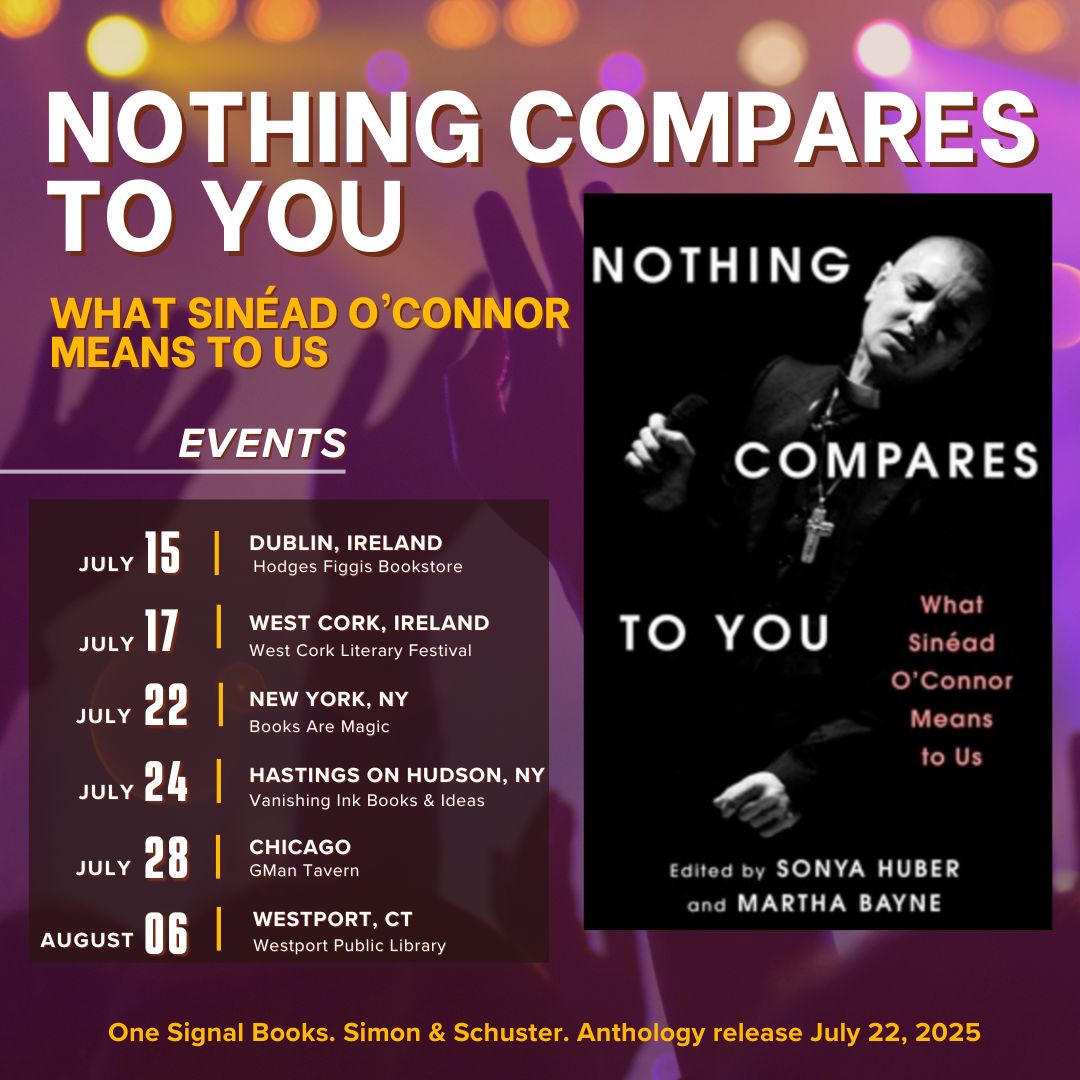
We’ve got more events and we hope you will join us for some!
- July 15, 2025: Dublin, IrelandHodges Figgis Bookstore, 56-58 Dawson St, Dublin: Discussion and readings with Martha Bayne, Mieke Eerkens, Sinéad Gleeson, and Allyson McCabe, with journalist Una Mullalley as moderator. 6pm.
- July 17, 2025: West Cork, IrelandWest Cork Literary Festival: Discussion and readings by Martha Bayne, Mieke Eerkens, and Allyson McCabe.
- July 22, 2025: New York, New YorkBooks Are Magic, 122 Montague St., Brooklyn, NY 11201. Launch event with Sharbari Ahmed, Martha Bayne, Sonya Huber, Porochista Khakpour, and Zoe Zolbrod.
- July 24, 2025: Hastings on Hudson, New YorkVanishing Ink Books, 2 Spring Street, enter on Southside Ave.
Hastings On Hudson, NY 10706 - July 28, 2025: Chicago, IllinoisGMan Tavern: (Bar attached to Cabaret Metro) Book talk and party with Martha Bayne, Sonya Huber, Zoe Zolbrod, Megan Stielstra, and Gina Frangello -- plus musical performances of Sinead O'Connor songs by Amalea Tshilds, Marydee Reynolds, Jane Roberts, Nora O’Connor, Jeanine O’Toole, Eiren Caffall, Julie Pomerleau, and L. Wyatt. 3740 N Clark St. | Chicago, IL 60613
- August 7, 2025: Westport, Connecticut7 pm: Launch Party with readings by Sharbari Ahmed, Sonya Huber, and Nalini Jones. Westport Public Library, 20 Jesup Road Westport, CT 06880 203.291.4800
- Other events TBA!
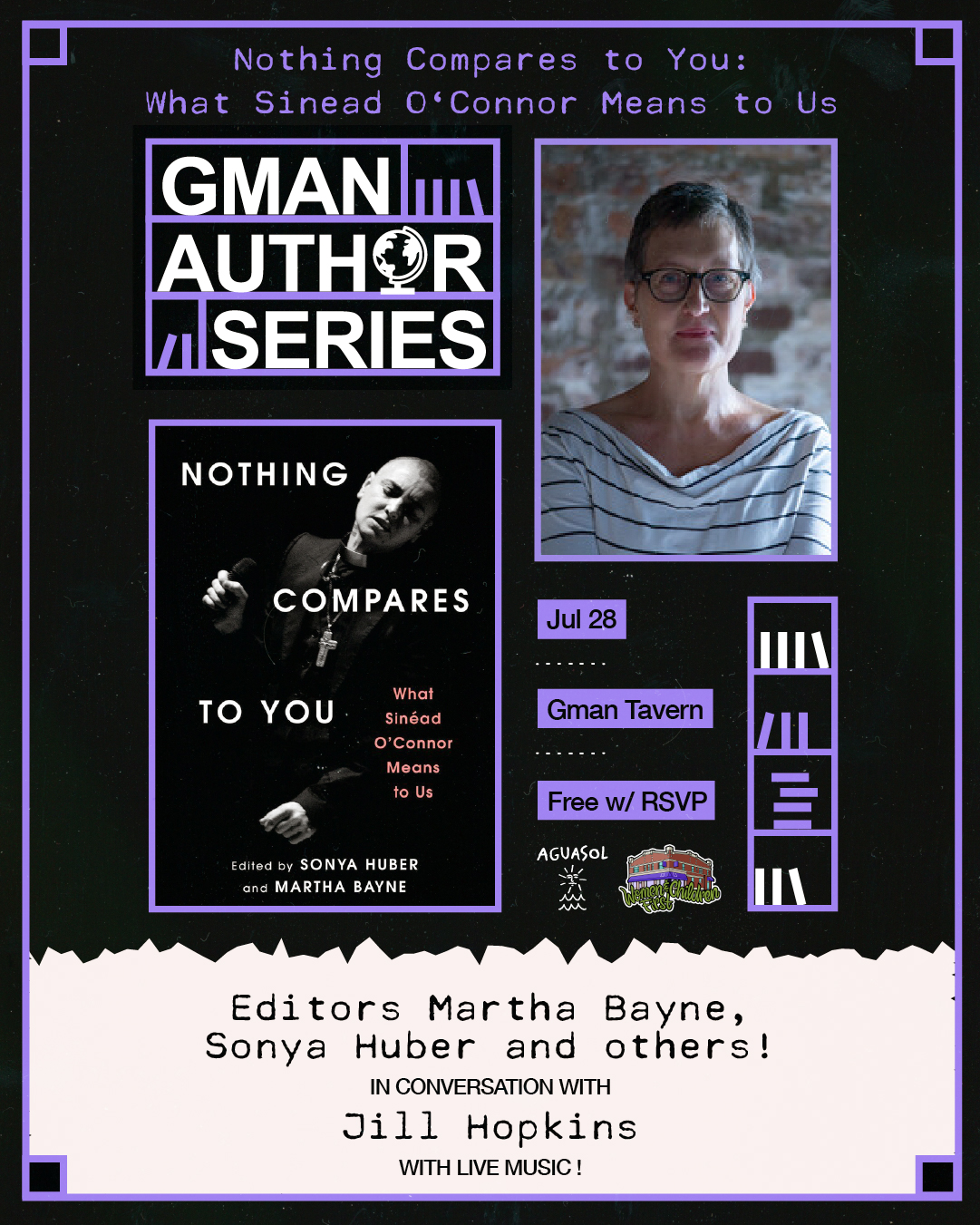
Let me know if you have any questions, if you want a review copy, if you want to host an event, or anything else!
xoxoxox
Sonya