Organizing #2: We Have to Honor Our Work
On Fighting Shame and Engaging Reflection
I imagine that most folks who are reading this have had the past couple of days that I have: watching the news of the appointments blip up on my phone, panicked snatches of disbelief with friends. I read this excellent but—fair warning, terrifying—piece by Jeff Sharlet about Pete Hegseth and it sent me round the bend. I’m telling you: if you’re not in a good place, save it for later.
As my own peace fragmented over the last 24 hours, I started locking down my social media a bit. To explain my actions, I sent it to to voters who probably chose Trump. These people are super-close to me, at least by drawing family trees, and the fascinating thing was that neither of them read it. That’s a strategy. And that’s where people are at. People who know how to read, who went to the voting booth and chose him, are uninterested in the world outside their bubble. For good reason, of course—that’s how denial works.
Do not let anyone tell you that you are living in a bubble. The bubble is large, and it is red.
If something major goes wrong—even something completely out of my control, like an illness or someone doing something terrible to me—my first tendency has been to blame myself. So as explanations circulated this past week about what “the Dems” did wrong, I found myself reflecting on all those questions. But I am happy with everything I did: the hundreds of hand-written postcards, the calling shifts, and the specific choices I made to support Harris loudly, despite wishing she would move on certain issues, knowing she had only 100 days. I acted strategically, understanding what was at stake and what the likely outcome would be if I and others did not.
Weirdly, in the aftermath, most of what we are defining as “success” right now—make a podcast like Joe Rogan! Own a major brainwashing news network and be super-rich!—is trying to figure out how to be more like the extreme right, which—no thank you. There are many ways to succeed, not just on their template.
Many of us worked hard. But the explanations that proliferate now have started to lay blame on us: where we choose to live, geographically, what social circles we frequent, and so on, the fact that we were born with a certain gender and sexual orientation. Each time I feel myself lured into one of those traps and start to feel shame for existing, I have to remind myself that that habit is very old. I learned it very young. You’re different; you get what’s coming to you because you dared to open your mouth. I learned to get very quiet, and even learned to be depressed, because it turned out that not moving, not speaking, was conducive to survival.
I learned it, in fact, in places that went for Reagan in the 1980s and stayed red. I learned these habits of withdrawing when I’m bullied by the very people who are now Trump voters in my very Republican hometown in Illinois.
Compare this shrinking and turning inward with how the other side has responded when they’ve lost: rage. Attempts to take over a national capitol building, with death resulting. There was no shame or reflection there. Instead there was a desire to break things, because breaking things is easy. And hell, they’re mad that they won!
Breaking is a child’s game, a toppling of the blocks of a tower with a crash that bestows “maximum impact for minimum effort.” (from Brian Boyd’s On the Origin of Stories: Evolution, Cognition, and Fiction,185) Developmentally, it’s a desire to learn cause and effect and to see one’s impact on the world. Adults aren’t supposed to get stuck in that stage, but sometimes they do. Because it’s emotionally satisfying. If they’re addicted to the rush of destruction and harm, it’s a shot of dopamine every time someone gets hurt or something breaks. And for many, that’s enough.
It’s very easy, once you’ve been blamed for things beyond your control your whole life, to put that on like a cloak and accept that bad things happen because you, personally, should have done something different. Should be different. Are the problem. I think reflection, analyzing what strategies might have worked and might work next time, is fine, and it uses our intelligence. But shame isn’t reflection.
Some of the reflecting I’ve been doing has been in thinking about advice from Black women and men on social media about how white people need to consider disengaging with Trump voters in our lives. I’ve started to take concrete steps. In the future, I’m going to be thinking more carefully about how my effort is not and has never a mutual exchange; that energy, care, or consideration is not returned at the point where it is most visible, the points at which I and those I love are considered to be fully human, considered as human beings with futures who will absolutely be endangered. Most of the time I’m just condescended to as someone with not much of a brain in a cushy job. I was having to actually remind myself after these conversations that I’ve written books and have degrees. I know that sounds bonkers, but that was where I was at. It’s old: it rattles the cages of my very sense of reality every time.
So I’m going to redirect my attention and let some things go, knowing full well that I tried. I and many others tried. So that I can be freer to do good work. I’m going to lighten my own burdens, which brings peace. I’m gonna stop trying, because their brains have some grooves worn in them that I cannot change.
In the coming months, things that were painstakingly built to serve the people of this country will start to break. Even as the other side is mowing swathes of destruction, we will be blamed for it. Your demographic, your town, your gender, your job category: they will all be blamed. (And by the way, a hearty NOPE to any Democratic strategist who says now’s the time to dump trans people.) Abusers will hurt you and then say “You made me do it.” There will be no accountability. There will never be a reckoning on the part of the breakers for what will be broken. Many of them will die after having lived a long life where they refused to even glance at a list of the things that were broken.
We will agonize over strategy about what we could have done better to protect these various things from breaking. We will continue to fight and maneuver and exhaust ourselves to minimize the damage. And that’s the moral thing to do when someone takes a gun into a school building, for example. You try to preserve life.
We didn’t make this happen. We all fought to prevent this from happening. Some of us might come up with brilliant strategies to save pieces, and to prevent this from happening again. We should not, as we try to survive the years ahead, let the shame of destruction into our hearts. We should take pride in what we do and what we have done.
We have to honor our work.
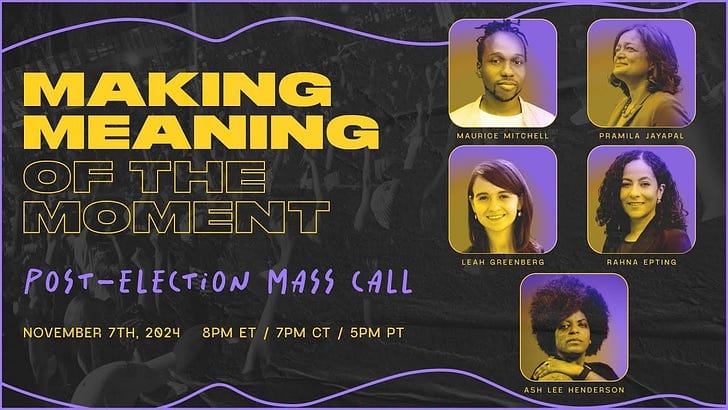
This was one of a million helpful messages from this recent online meeting now living on YouTube) from the Working Families Party Mass Call after the election. Judith LeBlanc, citizen of the Caddo Tribe of Oklahoma and Executive Director of the Native Organizer’s Alliance, spoke at the beginning of the call and said, “We have to honor our work.”
Many of us have been trained to expect so much of ourselves as we have rushed our whole lives, with endless to-do lists to the point of exhaustion, to compensate for the wreckage around us and the wreckers. On top of that, we have been told that that wreckage is our fault. Clarity means seeing everything we have done to protect ourselves and others, and loving ourselves for all of our hard work.
I honor everything you did to prevent this from happening. I honor and respect everything you will try to do in the years ahead. I honor everything we will do together, every time we listen to guidance from movement organizers and listen to strategy that makes sense and is keyed into the details around us, every time we join community efforts that consider consequences, every time our love extends beyond people who look like us and extends to our communities and beyond.
We will be blamed for everything. Women will be blamed. Communities of color will be blamed. Trans and queer people will be blamed. Teachers, librarians, civil servants—the exact people who have been just trying to help—will all be blamed. These are the tactics of a movement that is desperately trying not to see its own hands and actions as it sets fires, topples institutions, and proliferates harm. Every time we show up to fight this, we are doing good work. You are alive, at a computer, taking in information, thinking about the world. I honor you and your daily work.