Play, Mosaics, and Tangents
On María Lugones, Rebecca Makkai, and abandoning perfectionism
I’m in the land of the perimenopausal brain, I suppose. I’ve never been so scattered, and I know this is partially because of the stress that my family has been under these past months. As I get more scattered, more and more videos about ADHD show up in my various social media timelines. And I have always had challenges with linear thinking and outlines and calendars and spreadsheets, a lifelong issue with flipping digits and not being able to see numbers. These are getting more pronounced, in some ways. I related so much to the series that Rebecca Makkai wrote recently on ADHD.
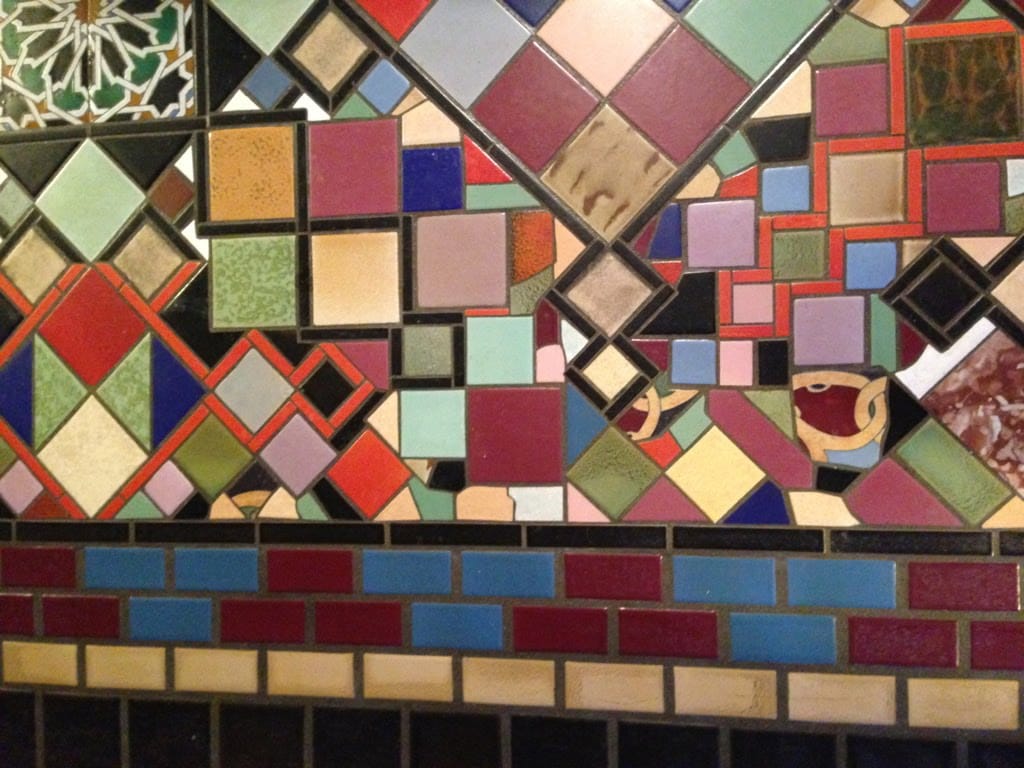
I am self-diagnosed, as someone who’s been noted by scores of people to be “weird,” but my brain has a system that is working for me. Rather than keeping all the plates spinning, I have adapted to become a part-time mosaicist, and the occasional artfully shattering plate is part of my circus act.
I was talking with my friend Abby the other day as we walked through a cool Audubon Center trail near where I live, and she was saying that she’s noticing all of these tendencies amping up in her brain, too. Maybe it’s the pandemic. Maybe it’s the days and weeks and months and years and their impact. Maybe it’s the fading of estrogen—or just being soul-tired.
But it feels like a rewiring, similar to the rewiring that happened after I had my son. New research indicates that the mommy brain” fogginess might actually be a “superpower,” a rewiring that should be named “matrescence” that is akin to brain growth during adolescence (and here it is in real time—cannot remember how to spell adolescence and had to look at the world four times after I googled it.) A neuroscientist’s lab happened to also look at neurological studies between 2009 and 2019 and found that there are still today NINE times as many studies on the male brain as on the female.
I feel like I am rewiring again now, in my fifties. And what if the transition to young elder feels so scattered because the net—of awareness, of connections, of empathy—is growing even wider? And we have to lose a few words as a a result? In some ways I feel like I like this brain best. I like its wide scope.
And of course this means that I have gotten weirder, my projects have flung themselves in every direction. I needed to make a meme to show you my current creative practice:
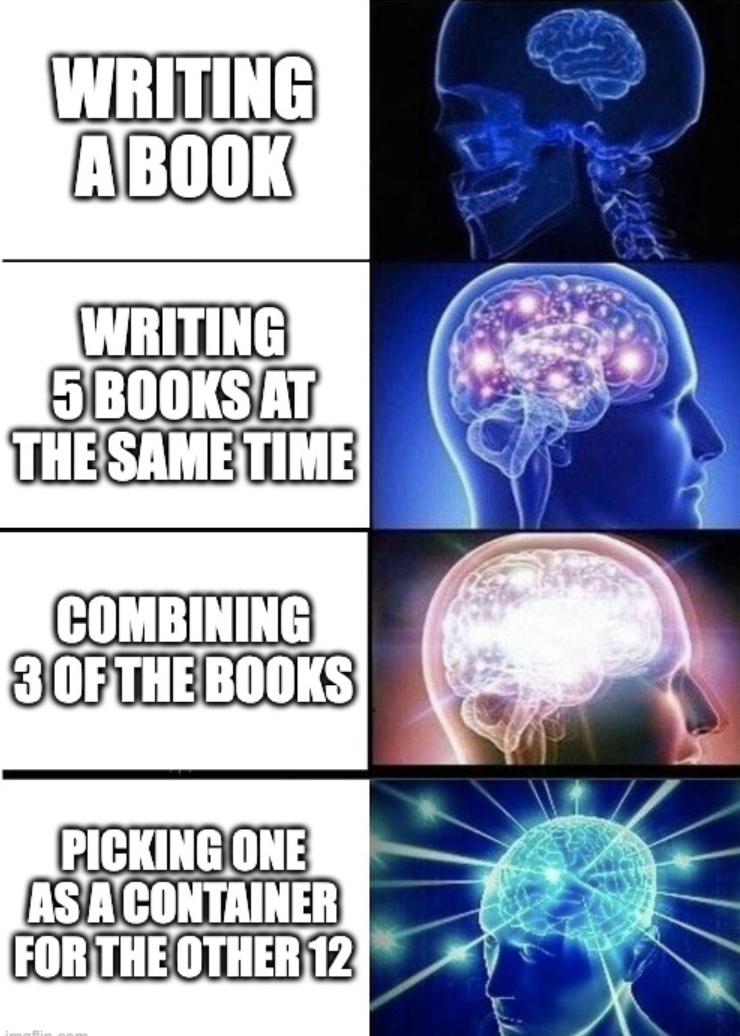
And, too, I think this is one of the weird fruits of not putting pressure to “unweird” myself, to have kept following the weirdness. All the weird thoughts are aligning. It’s fun. I like it.
A part of the gift of this expanding and scattered brain is that I am less afraid to break plates and drop balls. I have seen that that is essential, in fact, as a corrective to my early anxiety in which I developed a belief when very young that if I were “perfect,” I wouldn’t be scared anymore. It’s an understandable and common adaptation to different kinds of chaos, as if you are performing a magical spell of erasure with every action. The only problem is that it doesn’t work. I can honestly say that I have left perfectionism far behind and have been embracing the mess and the error.
Somehow, this is connected to me to FOMO (fear of missing out), an acronym my students in the 2010s taught me. My students of this decade still use and yet tell me is “old” and out of fashion, though they still feel it.
Every life is a series of missed connections, opportunities thwarted. I was just offered my first-ever fully funded residency since I am on sabbatical this spring, and I can’t go because I already committed to house-sit at a goat farm (a do-it-yourself residency that nets me a bit of cash). Having to write the “thank you but I can’t” email this morning was hard, even as I clicked on this website to this beautiful place where multi-disciplinary artists spend three weeks eating organic food in a fancy house. Dammit. But three weeks away doesn’t fit with life right now anyway.
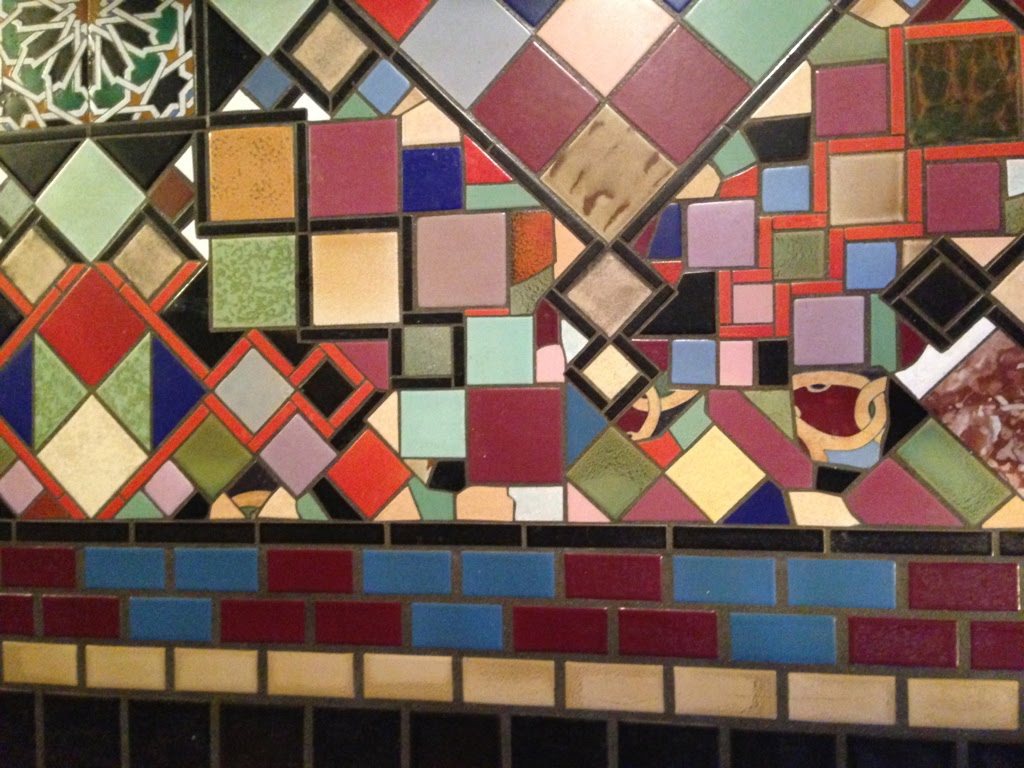
I have spent hours that have added up to days and weeks of my life quietly bashing myself for wrong decisions, for things I should have reached for but didn’t, things I tolerated instead. However, this morning I am grateful for the fact that all the missteps somehow trained a brain that is good with collecting the pieces and making a mosaic. I keep thinking here, too, of a mosaic that plays a central role in Rebecca Makkai’s book The Hundred Year House. If I ever meet her (I am such a fan) I will have to ask her about mosaics and our brains.
For some reason, the Rolling Stones’ song “You Can’t Always Get What You Want” is playing in my head as a soundtrack, and though I love the song, I disagree with its spiritual worldview. Clearly—look at the world, at Gaza—people emphatically do not always get what they need. But early on, that song was a kind of FOMO antidote for me.
And then in college, I had the mind-blowing opportunity to take classes with and be friends with the brilliant philosopher María Lugones, who passed away in 2020. She keeps peeking in as I write this, an association that I would probably need a book to unpack. But her vital essay, “Playfulness, ‘World’-Traveling, and Loving Perception” talks about the worlds we inhabit, what it means to move between worlds, what it means to love those we see as “other,” and the toxicity of the worlds that don’t allow us (or imagine us) as playful beings. (She connects this in a brilliant way to the ways of being of whiteness and white women and it has so many incredible ideas that I am not able to clearly explain. Check it out.) She writes:
“So then, what is the loving playfulness that I have in mind? Let me begin with one example: We are by the river bank. The river is very, very low. Almost dry. Bits of water here and there. Little pools with a few trout hiding under the rocks. But mostly is wet stones, grey on the outside. We walk on the stones for awhile. You pick up a stone and crash it onto the others. As it breaks, it is quite wet inside and it is very colorful, very pretty. I pick up a stone and break it and run toward the pieces to see the colors. They are beautiful. I laugh and bring the pieces back to you and you are doing the same with your pieces. We keep on crashing stones for hours, anxious to see the beautiful new colors. We are playing. The playfulness of our activity does not presup- pose that there is something like "crashing stones" that is a particular form of play with its own rules. Rather the attitude that carries us through the activity, a playful attitude, turns the activity into play. Our activity has no rules, though it is certainly intentional activity and we both understand what we are doing. The playfulness that gives mean- ing to our activity includes uncertainty, but in this case the uncertainty is an openness to surprise. This is a particular metaphysical attitude that does not expect the world to be neatly packaged, ruly.”
So there’s a way in which my rumination on the things I wanted and didn’t get is a demand that the world be “ruly,” that it not be in and of itself a riverbank where I can play, where stones break apart, where the spell of perfectionism doesn’t work and in fact is entirely forgotten.
If you’re looking for a diverting book (and I have been) I wanted to recommend an older one: The Agony and the Ecstasy by Irving Stone (1961). I love love love reading biographies of artistic process, and this is based on the life of Michelangelo. Do you imagine him kinda swanning around eating grapes and dabbing paint in the Renaissance? I did. But he had a hard road, and the novel is beautiful, and it will make you feel better about a life of artistic and other struggles. Plus you can learn a lot about warring city-states in the 1500s in Europe. I tried to sell this one to my husband, who loves history, but he said, “That’s too far back.”
I hope you get to smash things that didn’t work out and that you can play and make something cool with the pieces.