Un-Chainsaw
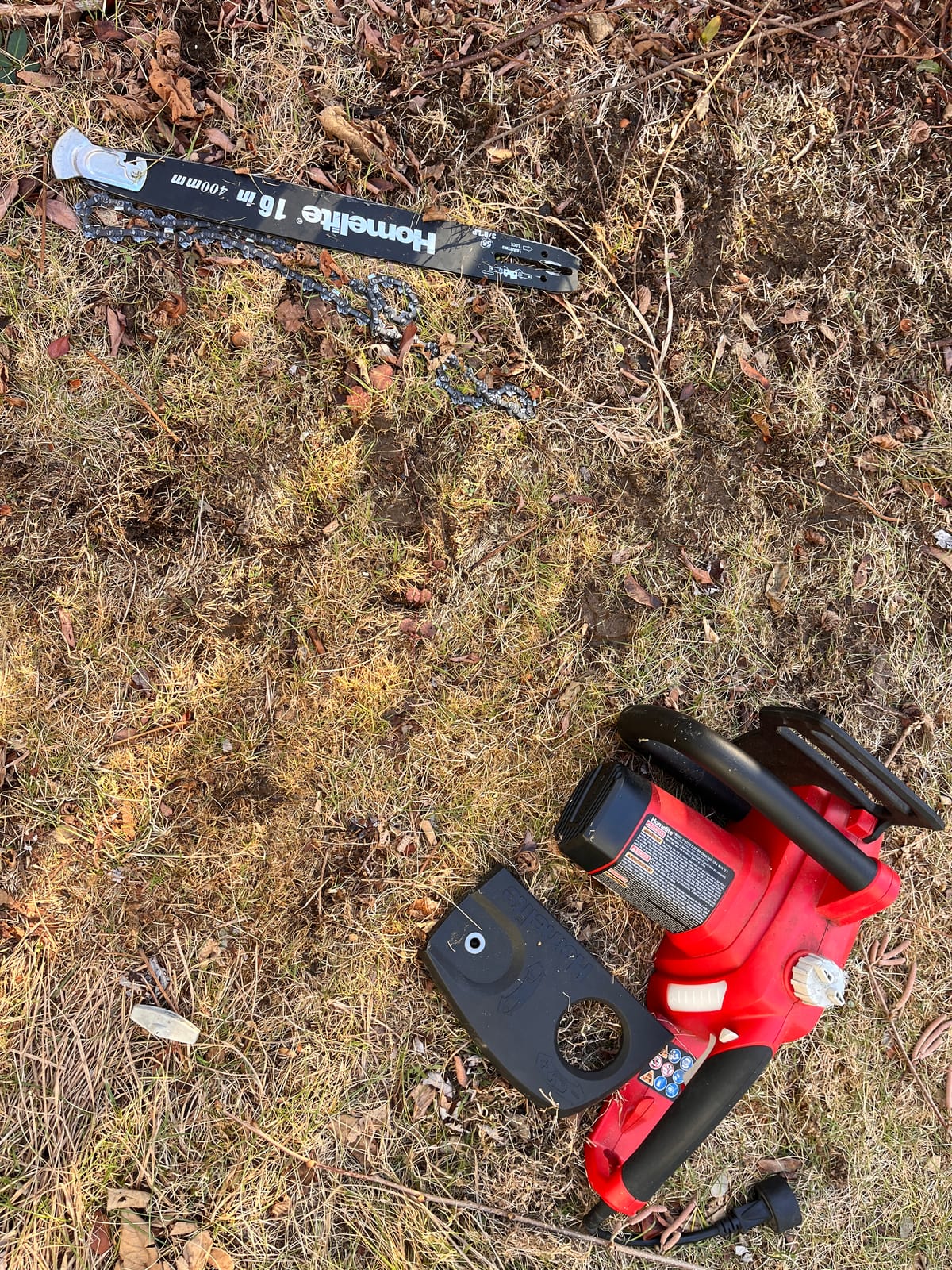
Yesterday, I was pruning some hazelnut bushes that have gotten out of control. The pruning book said to do this in “early spring,” and January might be too early, plus I know somehow hazelnuts fertilize in January. Sorry, Mother Earth. I was using a neat but old electric plug-in chainsaw I’d saved from the Goodwill pile when we were cleaning out my parents’ house last year. And this might be part of the issue: it was old. Fine, also stupidly dangerous, but it was a small chainsaw. A hobbyist chainsaw.
Of course I was doing this wrong; there’s a diagram in the book about cutting at a diagonal above a bud, and I’m just lopping away, but they were getting too tall, so I was bending over the long stems and lopping off the tops.
But also: let’s be clear, there is “bad” for the hazelnut bush and then there is BAD as in invading another sovereign country to steal its natural resources, or BAD as in the island of suffering. We know all this, but I am plagued every hour of every day by how we are all carrying this.
Anyway, as I was sawing away, the chainsaw began to un-chainsaw. I was both hearing the sound of the chainsaw above me and seeing pieces of plastic and metal fall around me to the ground. I stood there, looking at the pieces, wondering if that had been dangerous, that little experience, whether I had avoided through bald luck a terrible accident. I also had a weird flash of thinking this has happened to me before, that chainsaws are always un-chainsawing.
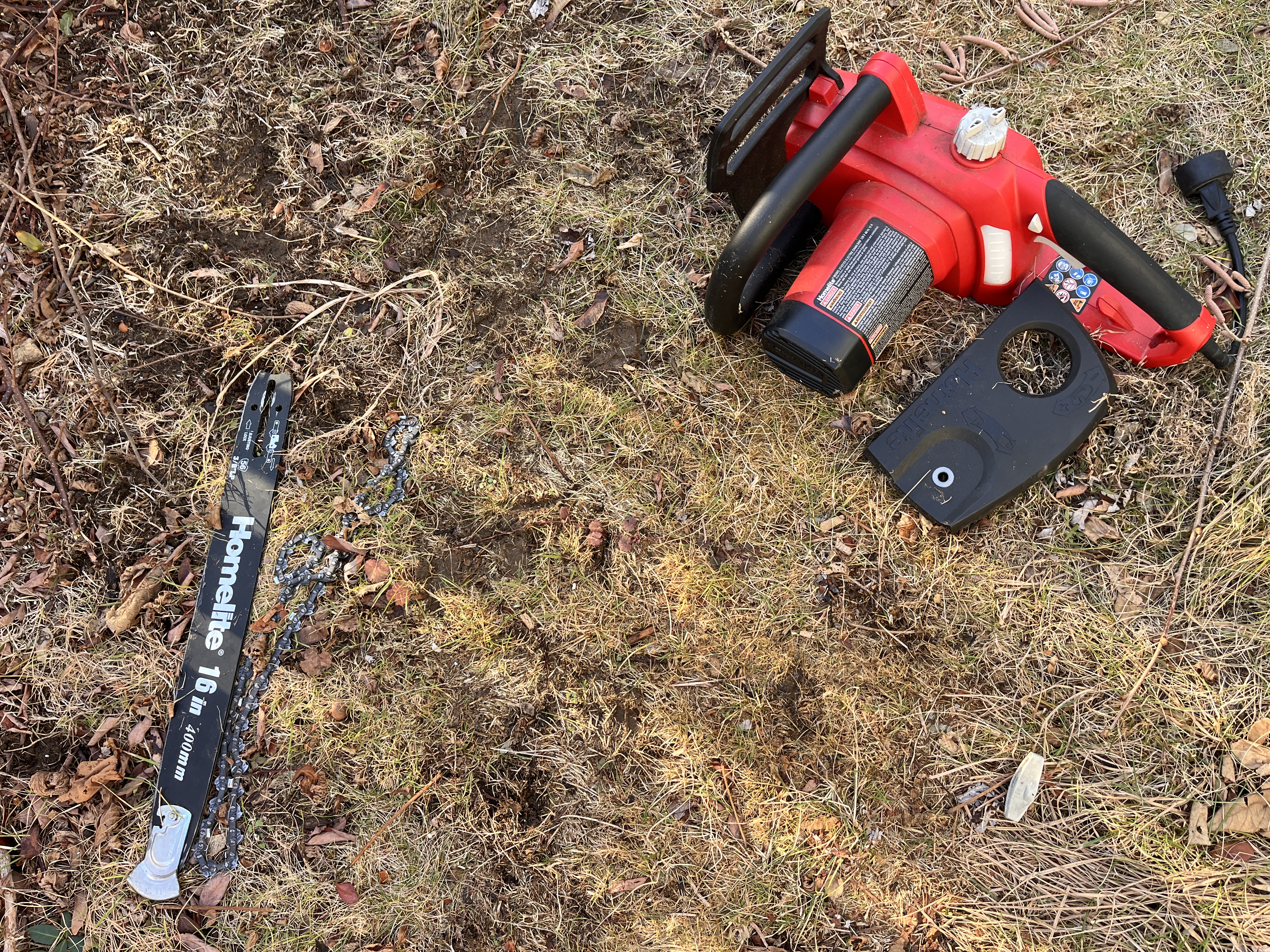
I thought, briefly, of how the brain does “fill in” work, smoothing and continuing perceptions to make sense of the world, and I wondered whether I could ever know at what point the chainsaw noise stopped and determine the moment that it had un-chainsawed.
This also feels like what I am doing a lot right now: staring into the middle distance and listening to the gears grind as I ask, “What is happening?” News-wise, I mean. It’s so extreme.
It raises this question that we used to have to meditate on when I was meditating a lot: when does a seed become a sprout? The point of the meditation is “looking and not finding.” In other words, it’s good practice for the brain to attempt to find a dividing line and to fail at that attempt. It doesn’t matter where we intellectually draw a line. What matters in terms of a seed becoming a sprout, or a chainsaw un-chainsawing, is what each cell in that sprout and each piece in that chainsaw does as it dynamically interacted with all the rest of the pieces. It’s the whole process.
I have to say I am proud of us, whatever happens. I personally adored Target and then when we had to all drive a spike in its eye, we were like, “Okay, Target, time to die.” The entire Corporation for Public Broadcasting went away yesterday. And then the news. You know what I’m talking about. All of it.
It’s also weird because my husband, who has had major mental health challenges over the past several years, has wisely decided with his therapist that he’s going to be on a complete news fast. I support this. And yet sometimes I have to say to him, “It’s a bad news day” to explain the fact that I want to scream into a snowdrift. So it’s this doubled and halved world where, inside of our house, the news-fire is everywhere but only I can smell the smoke.
We are in what I think I’ll call “the acceleration.” You’re doing laundry and watching the country dissolve. You’re doing it fine. I’m doing it fine. It’s getting freaking fast and we don’t know what direction it’s going, but this is the point in the car wreck where we’re spinning or launched mid-air. Any flicker in your heart that wants the chainsaw to un-chainsaw is good.
Rest in peace, Renee Nicole Good. Love to all my Minneapolis people. We are all enraged with you. Let’s un-chainsaw.
Books I’ve Loved
’s Art Above Everything: One Woman’s Global Exploration of the Joys and Torments of a Creative Life: Wow, if you need a balm from the hellscape, check this book out. It’s a series of researched chapters, each devoted to a woman artist, all around the world, who sacrificed for their creative work and made beauty. Griest’s voice is personal here, weaving in her own story, including her lineage and a cancer diagnosis and a major breakup and other struggles and joys, as she travels to and meets with these artists, watches them in community and gets to know them, watches them work, often physically engaging with the art or the creating itself. She writes in the urgent present tense, which gives these encounters a timelessness and immediacy. She continues to meditate through the book on this question throughout the book: “Is Art Enough"?
’s beautiful memoir, The Harder I Fight, The More I Love You. The language. This story. I will just give you quotes because the writing does all the work, and each of them is a fortune cookie for this present moment.
“An impression or phrase builds a little fire of feeling that causes you to react with construction paper and Popsicle sticks and grade-school poetry and Scotch tape. You work simultaneously forward and back from the middle. You must build its container and atmosphere, and you need to build it so you can live there, too. If you end up keeping the things you make that don’t match the scale of the other things it has to be an intentional ‘stylistic choice.’ You have to arrive at the answer just shy of ‘correct.’ You must be precise by eyeballing it, no measuring. It has to be exactly not right.” (184)
“In the middle of hard times, sometimes we can’t see the pieces that are taking shape around us, forming what’s going to get us to the next, better, place….As time went on, I began to understand in a new way the appearance of the horses when I was a kid—not as something that would swoop in and fix me, but as a force pushing me to keep orienting myself toward the cinnamon scent of what was right and good for me.” (186)
“So there I was at the big sink in the back, soaking wet and prune-wrinkled with a stomach rash from my warm, damp, and angry ambitions smashed inside my tight apron. My dreams thought I was a dick but suffered me anyway as I was trying to hang in there. My dreams pitied me, I could feel that.” (187)
“I don’t believe forgiveness is something you can actively do with any realness or sincerity. It’s not a tangible ‘act,’ in the same way that justice is not an act. Maybe forgiveness and justice are somehow the same state of being. Maybe forgiveness comes later, and maybe it never does. Maybe you are so evolved you can feel it right in the moment of betrayal. I have forgiven people and events before, and it’s usually after a long time and self-searching about something completely different. Forgiveness seems to be a sweet, brief rest at the crossroads of other things. It’s almost a divine by-product. It’s not a tiny golden diploma you bestow upon someone. Forgiveness takes many forms and may be as simple as the moment something no longer has any power over you.
That doesn’t mean that there aren’t good ideas about forgiveness and its beauty, but if something doesn’t stir anything but contempt in you, there’s a reason. Trust your contempt. Dissect it if you can. The reason your contempt is tapping you on the shoulder may be in there, and be valid, or it may not. If you can’t find it, it’s okay. That doesn’t mean you should canonize your rage, either, just make sure you take it seriously….Sometimes bad things are just senseless brutality that finds you. You do not deserve or ask for these things. They are not always teaching you a lesson.”